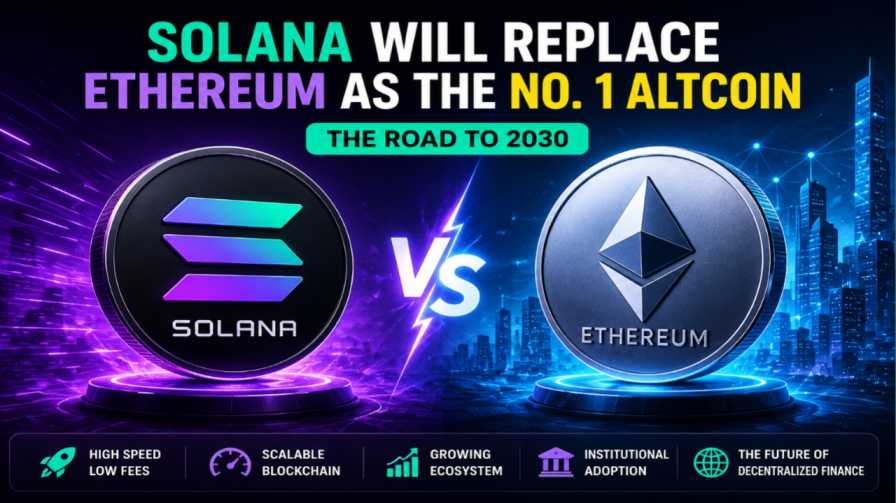
Solana is rapidly gaining market share with faster transactions and lower fees. Discover whether Solana can surpass Ethereum and become the leading altcoin by 2030.
The cryptocurrency market has long been dominated by two major names: Bitcoin and Ethereum. While Bitcoin continues to hold its position as the largest cryptocurrency by market capitalization, Ethereum has maintained its status as the leading altcoin for more than a decade. However, growing discussions within the crypto community suggest that Solana may be emerging as a serious challenger.
With faster transaction speeds, lower fees, and increasing adoption across decentralized finance (DeFi), many analysts believe Solana could significantly narrow the gap with Ethereum over the coming years. The question now is whether Solana has what it takes to become the top altcoin by 2030.
Why Solana Is Gaining Attention
One of Solana’s biggest advantages is its high-performance blockchain infrastructure. Compared to Ethereum, Solana offers faster transaction processing and significantly lower transaction costs. These benefits have attracted developers, traders, and blockchain projects looking for a more efficient platform.
As blockchain technology becomes more widely used, scalability and affordability are becoming increasingly important. Solana’s ability to process thousands of transactions per second has helped it gain popularity among users who want faster and cheaper blockchain interactions.
Growing Presence in the DeFi Sector
Decentralized Finance remains one of the most important sectors within the cryptocurrency industry. Over the past few years, Solana has steadily increased its presence in this market.
Many decentralized exchanges and DeFi applications have chosen Solana because of its lower operating costs and improved user experience. As more liquidity and trading activity move to the network, Solana continues to strengthen its position as a major blockchain ecosystem.
This growth has allowed Solana to challenge Ethereum’s long-standing dominance in several areas of decentralized finance.
Shift Toward Institutional Adoption
Another factor driving optimism around Solana is its growing focus on institutional use cases. The blockchain is increasingly being used for stablecoins, tokenized assets, and financial applications designed for larger investors and organizations.
Tokenization of real-world assets has become one of the fastest-growing trends in the crypto industry. Financial institutions are exploring blockchain technology to improve efficiency and reduce settlement times. Solana’s speed and low fees make it an attractive option for these emerging opportunities.
As institutional participation in digital assets increases, networks capable of handling large transaction volumes efficiently could benefit significantly.
The Challenge of Surpassing Ethereum
Despite Solana’s impressive growth, replacing Ethereum as the leading altcoin remains a difficult task.
Ethereum currently maintains a much larger ecosystem, stronger developer community, and significantly higher market capitalization. Thousands of decentralized applications, smart contracts, and blockchain projects continue to rely on Ethereum’s network.
To overtake Ethereum, Solana would need to sustain rapid growth for several years while continuing to attract developers, users, and institutional investors. It would also need to maintain network stability and strengthen trust among market participants.
What Could Happen by 2030?
If Solana continues expanding its ecosystem, attracting institutional adoption, and capturing market share from competing blockchains, it could become one of the strongest contenders in the crypto market by 2030.
The future will likely depend on several key factors:
- Continued growth of decentralized finance
- Expansion of stablecoin usage
- Adoption of tokenized real-world assets
- Network reliability and security
- Developer activity and ecosystem growth
While Ethereum remains the dominant altcoin today, Solana’s rapid development suggests that the competition between the two networks will become even more intense in the coming years.